Affiliate operations
How to hand over affiliate link management
Affiliate link maintenance becomes difficult when the same recommendation appears in articles, storefronts and social content with no shared record. A useful handover explains where links live, how they were created, what may be changed and who approves a replacement. This guide outlines a practical process you can use when bringing in ongoing support.
All insights & guides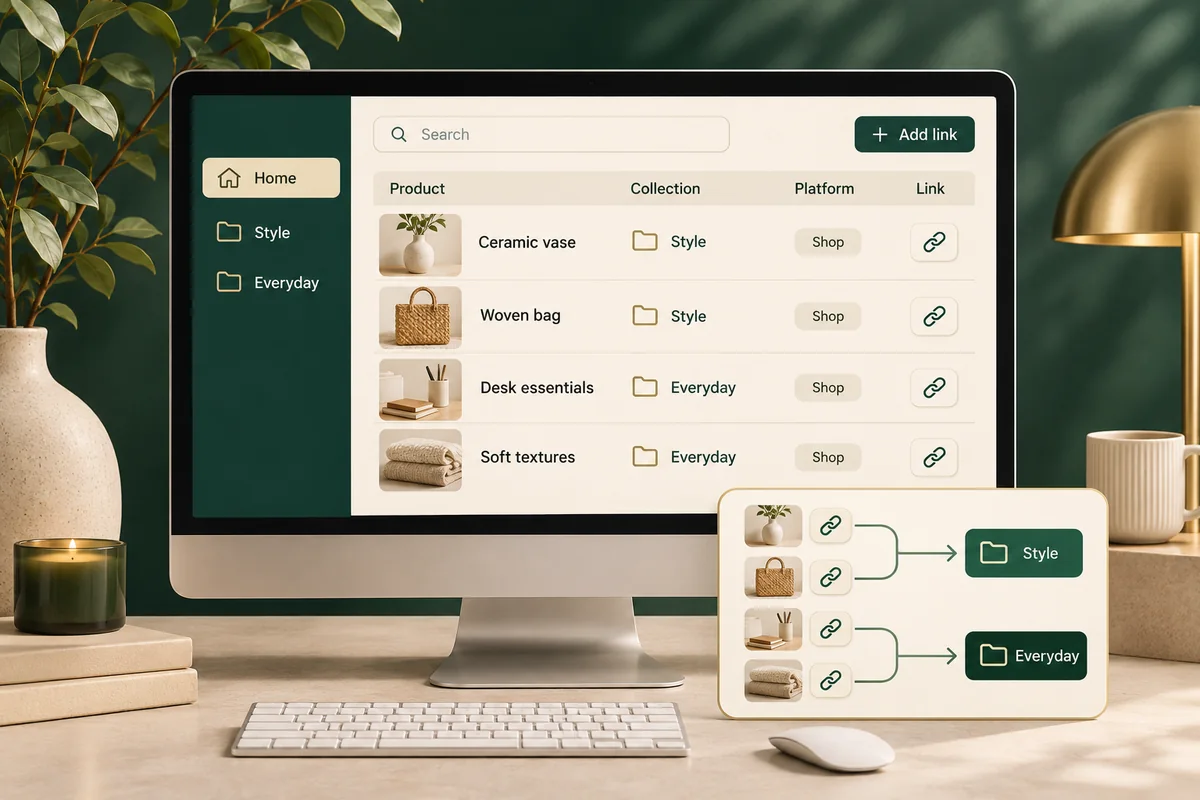
Start with placements, not a loose list of URLs
A spreadsheet of destination URLs does not show where a correction must be made. Record each published placement alongside the product it represents. A placement might be a button in an article, a collection item or a link in a profile. If one product appears in several places, keep those relationships visible.
Start with the content you are actively maintaining. You can extend the inventory in batches rather than delaying useful work until every historical post has been catalogued. Mark the scope clearly so the handover does not imply that unreviewed content has been checked.
| Field | Why it helps |
|---|---|
| Placement URL and location | Shows the page, collection or block that needs an update. |
| Product and variant | Distinguishes similar items, sizes or models. |
| Published affiliate link | Preserves the exact link currently in use. |
| Destination and market | Records the intended product page and audience location. |
| Program or platform | Identifies the approved tool used to create or manage the link. |
| Status and last check | Separates reviewed, unresolved and untouched records. |
| Owner and approval | Makes the next decision and responsible person visible. |
Define what a meaningful link check includes
A successful page response is only one part of the check. The destination may open while showing a different product, an unavailable variant or a page that no longer matches the recommendation. Record what you could actually verify instead of treating every reachable address as correct.
Check the visible destination, product identity and surrounding copy together. If you cannot verify availability for a particular market or account state, flag that limitation. Do not guess at what a different visitor will see. A useful status is specific enough for the owner to decide what to do next.
- Reviewed: the intended item and placement match at the time of checking.
- Needs owner review: a replacement or wording decision is required.
- Unable to verify: access, market differences or another limitation prevents a reliable check.
- Updated: the approved change has been published and checked.
- Not yet checked: the record is in the inventory but has not been reviewed.
Set rules for unavailable products and replacements
Decide whether a manager can remove an item, recommend an alternative or make a replacement only after approval. A similar-looking product is not automatically equivalent. The original recommendation may depend on a feature, material, price expectation or personal experience that the alternative does not share.
Ask for the reason behind a proposed replacement and identify every affected placement. If a comparison article discusses a particular model, changing the button alone may leave the article inaccurate. Review titles, descriptions and images alongside the new destination.
Use the platform's own link workflow
Keep the published affiliate URL intact in the inventory. When replacing an item, use the program's approved tools and retain the resulting link. Avoid applying a blanket cleanup that removes parameters from existing affiliate links; that can remove information you intended to preserve.
ShopMy supports moving an existing link to another collection or duplicating it into a collection. Its guide explains that duplicated placements are tracked separately. Decide which operation fits the content change before making it, and record the placement that was actually updated.
Reference: ShopMy: editing links and collections
Keep account credentials, payment details and recovery information out of the inventory. Document who owns the account and how work is authorized instead. Where access is limited, preparation and owner approval can remain separate from publication.
Keep a change log someone else can follow
Record the old value, new value, reason, affected placement and approval for each published change. This provides context if the owner questions an update later and makes it easier to reverse an incorrect edit. A short note written when the work happens is usually more useful than a long report reconstructed at the end of the month.
For a website, use the available revision or backup process before a larger batch of changes. Review a small sample first to confirm the formatting and replacement method, then complete the remaining approved items. Recheck the public pages after publishing rather than relying only on the editing interface.
- What was changed, and where?
- Why was it changed?
- Who approved a substantive replacement?
- Was related copy or imagery reviewed?
- What remains unresolved, and what decision is needed?
Choose a maintenance rhythm around the content
Agree on a review schedule that reflects how the content changes. A short campaign, a seasonal collection and an evergreen guide can need different attention. If you have reliable traffic information, use it to prioritize important placements; otherwise start with current promotions and the content you actively share.
Define a route for urgent issues between planned reviews. The person who notices a broken recommendation should know where to report it and what information to include. Keep the schedule realistic enough that exceptions are visible instead of silently accumulating.
Make the handover demonstrate the process
Before ongoing work begins, walk through one reviewed link, one proposed replacement and one unresolved item together. Confirm that another person can find the placement, understand the status and identify the next action without searching through private messages.
The handover should include the inventory, selection rules, access arrangements, approval process and change log. Ask for reporting on completed checks, published changes and open decisions. These records show what the maintenance service delivered; they should not be presented as proof of commissions or revenue that has not been measured.